
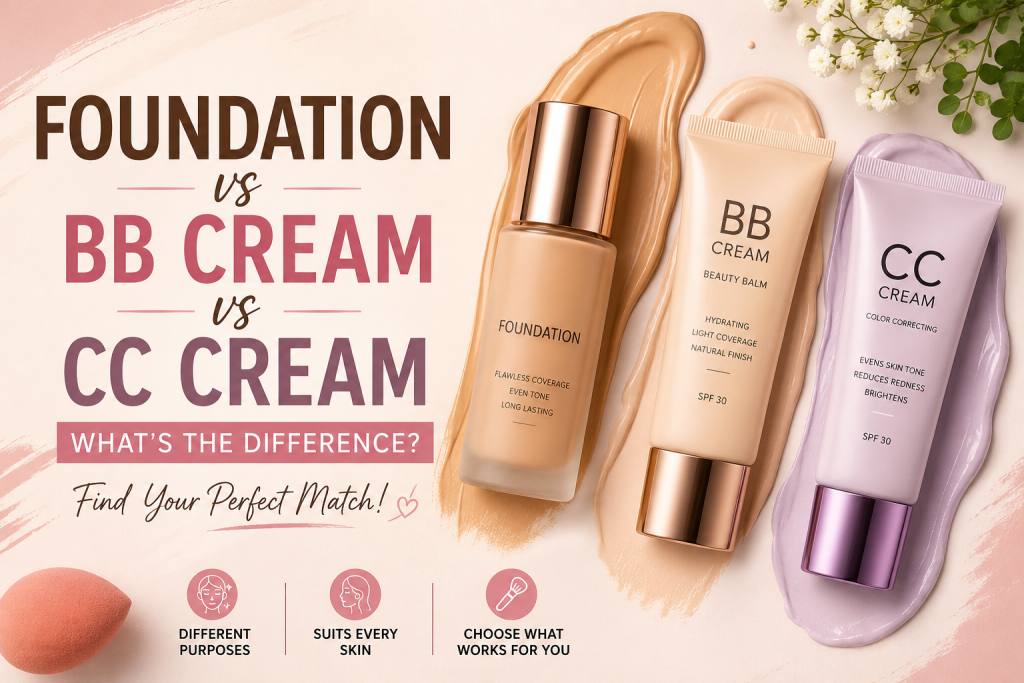

Have you ever stood in the beauty aisle wondering whether you should buy a foundation, BB cream, or CC cream?
You’re not alone.
While all three products are designed to improve your complexion, they serve different purposes. Some provide full coverage for a flawless look, while others focus on hydration, sun protection, or color correction.
If you’ve ever been confused about which one belongs in your makeup bag, this guide will help you understand the differences and choose the perfect product for your skin.
Understanding the Basics
Before comparing them, let’s understand what each product is designed to do.
Foundation
Foundation is a makeup product created to provide an even skin tone and cover imperfections such as acne scars, pigmentation, redness, and blemishes.
It offers the highest level of coverage and is available in different finishes like matte, satin, natural, and dewy.
Foundation is ideal for people who want a polished, long-lasting makeup look.
BB Cream (Beauty Balm)
BB Cream stands for Beauty Balm or Blemish Balm.
It combines light makeup coverage with skincare benefits, making it perfect for everyday wear.
Most BB creams contain ingredients that moisturize the skin and often include SPF to protect against sun damage.
Think of it as a tinted moisturizer that gives your skin a naturally fresh appearance.
CC Cream (Color Correcting Cream)
CC Cream means Color Correcting Cream.
Instead of providing heavy coverage, it focuses on correcting uneven skin tone.
If your skin has redness, dullness, mild pigmentation, or discoloration, CC cream helps neutralize those concerns while still giving a natural finish.
Many CC creams also include skincare ingredients and SPF.


Foundation vs BB Cream vs CC Cream: Quick Comparison
| Feature | Foundation | BB Cream | CC Cream |
|---|---|---|---|
| Coverage | Medium to Full | Light to Medium | Light to Medium |
| Best For | Acne marks, pigmentation, blemishes | Daily natural makeup | Redness, dullness, uneven skin tone |
| Finish | Matte, Satin, Natural, Dewy | Natural or Dewy | Natural |
| Skin Benefits | Some formulas include skincare | Moisturizing, SPF, skincare | Color correction, skincare, SPF |
| Wear Time | Long-lasting | Moderate | Moderate |
| Ideal Occasion | Parties, weddings, events | Office, college, everyday wear | Everyday with skin tone correction |
What Is Foundation?
Foundation is a makeup product designed to create an even skin tone by covering imperfections such as acne, pigmentation, redness, and dark spots.
It comes in different finishes, including:
- Matte
- Dewy
- Natural
- Satin
Foundation also offers different coverage levels:
- Light Coverage
- Medium Coverage
- Full Coverage
Best For
- Weddings
- Parties
- Professional makeup
- Photoshoots
- Long workdays
- Glam makeup looks
Pros
✔ High coverage
✔ Long-lasting
✔ Available for every skin type
✔ Wide range of shades
Cons
✘ Can feel heavy if applied too much
✘ Requires proper blending
✘ Usually needs primer and setting powder
What Is BB Cream?

BB stands for Beauty Balm or Blemish Balm.
Think of it as a combination of:
- Moisturizer
- Light foundation
- Sunscreen (in many formulas)
- Skincare ingredients
It gives your skin a fresh, natural look while providing light coverage.
Best For
- Everyday makeup
- College
- Office
- Beginners
- Minimal makeup lovers
Pros
✔ Lightweight
✔ Hydrating
✔ Quick to apply
✔ Gives a natural finish
✔ Great for dry and normal skin
Cons
✘ Doesn’t cover acne or pigmentation well
✘ Fewer shade options
What Is CC Cream?
CC stands for Color Correcting Cream.
It is specially formulated to reduce uneven skin tone by neutralizing discoloration.
Different color-correcting pigments help target different concerns:
- Green → Redness
- Peach/Orange → Dark circles
- Lavender → Dullness
- Yellow → Purple undertones
CC cream provides slightly more coverage than BB cream while still feeling lightweight.
Best For
- Redness
- Acne marks
- Uneven skin tone
- Mild pigmentation
- Sensitive skin
Pros
✔ Corrects skin discoloration
✔ Lightweight
✔ Natural-looking finish
✔ Often contains skincare ingredients
Cons
✘ Less coverage than foundation
✘ Not ideal for heavy acne coverage
Which One Should You Choose?
Choose Foundation If:
- You want flawless coverage.
- You have acne scars or pigmentation.
- You’re attending weddings or events.
- You need makeup that lasts all day.
Choose BB Cream If:
- You prefer a natural look.
- You’re a beginner.
- You want something quick and lightweight.
- You have relatively clear skin.
Choose CC Cream If:
- You struggle with redness.
- You have an uneven complexion.
- You want a natural finish with added color correction.
- You like makeup that feels light but offers a bit more coverage than BB cream.
Can You Use Them Together?
Yes! Many makeup enthusiasts combine them for a customized finish.
For example:
- Use CC cream to neutralize redness.
- Apply foundation only where extra coverage is needed.
This technique creates a natural-looking complexion without making the makeup feel too heavy.
Tips for a Flawless Base
- Always start with clean, moisturized skin.
- Apply sunscreen during the day, even if your makeup contains SPF.
- Blend well around the jawline and neck.
- Choose a shade that matches your neck for the most natural look.
- Set your makeup with powder or setting spray if you need longer wear.
Final Thoughts
There’s no single “best” product—only the one that fits your skin, lifestyle, and desired finish.
- Foundation is your go-to for full coverage and long-lasting wear.
- BB Cream is perfect for effortless, everyday beauty.
- CC Cream is the ideal choice when you want to even out your complexion while keeping your makeup light and comfortable.
Understanding the purpose of each product makes it easier to build a makeup routine that enhances your natural beauty without unnecessary complexity.

